

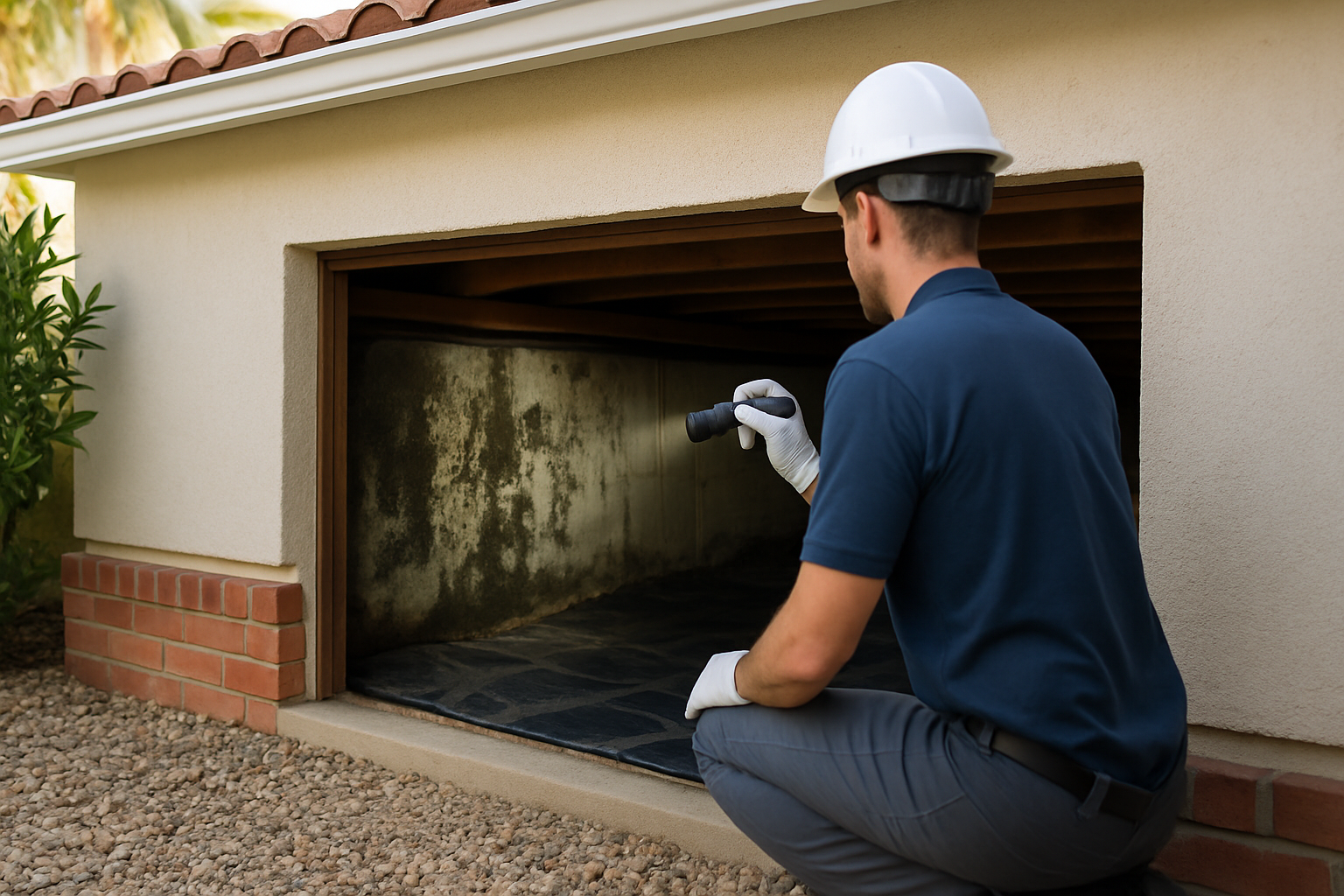
The hallway smells faintly like a wet towel left in a gym bag. You have cleaned, you have aired the house out, and the smell keeps coming back. Nothing upstairs looks wrong. In a lot of older San Diego homes, the answer is under the floor, in a dark vented space almost nobody checks.
Key Takeaways
- ›Cool coastal air plus a damp dirt floor is the local recipe for crawl space mold.
- ›Musty smells, cupped flooring, and higher allergy symptoms usually show up before you see any growth.
- ›Cleanup runs roughly $1,500 to $4,000, and it only lasts if the moisture source gets fixed.
Why San Diego Crawl Spaces Grow Mold
San Diego does not get the driving rain that soaks homes in wetter states. That is exactly why crawl space moisture goes unnoticed here for years. The water arrives slowly instead of all at once.
The Marine Layer Does the Quiet Work
From late spring into summer, the marine layer parks over the coast most mornings. That air is cool and close to saturated. It drifts through foundation vents into a crawl space that sits several degrees cooler than the yard.
When humid air touches a cooler surface, moisture condenses out of it. Under your house, those cooler surfaces are the floor joists, the ductwork, and the subfloor. Homes in Ocean Beach, Point Loma, La Jolla, and Pacific Beach see this pattern most often.
Where the Water Actually Comes From
Condensation is only part of it. Ground evaporation pushes vapor up from bare soil every day of the year. The US Department of Energy notes that soil moisture enters a crawlspace as liquid water or vapor. From there it condenses on floor joists.
Add a slow supply line drip or a weeping drain connection and the space never dries out. A pinhole leak under the house can run for months without showing a stain anywhere you would look. That is why a musty smell often beats a water bill spike as the first real clue.
The Signs You Can Spot Without Going Under the House
Most crawl space mold San Diego homeowners find is discovered from inside the living space, not from crawling around with a flashlight.
What You Smell and Feel First
An earthy or sour smell near floor vents is the classic one. It usually gets stronger on humid mornings and after the heat runs. Floors may feel cold or slightly spongy in spots.
Allergy symptoms that ease when you leave the house are another signal. Air moves upward through a home as warm air rises. Whatever is growing below you does not stay below you.
What a Flashlight Shows
If you can safely open the access hatch, look for white or gray fuzz on the underside of the subfloor. Look for dark staining along joist edges. Check whether the plastic ground sheet is torn, missing, or bunched up.
Standing water is not required. Damp soil that never quite dries is enough to keep growth going.
What It Does to the House and to the People Inside
Two separate problems run at the same time, and they move at different speeds.
The Structural Side
Wood stays sound below about 20 percent moisture content. Past that, decay fungi go to work on joists, rim boards, and subfloor panels. Repairs stop being a cleaning job and start being a carpentry job.
Insulation is usually the first casualty. Wet fiberglass sags out of the joist bays, loses its R-value, and holds moisture against the wood.
The Air You Breathe Upstairs
The CDC reports that mold exposure can cause a stuffy nose, coughing, wheezing, burning eyes, or a skin rash. People with asthma or a mold allergy can react much more strongly. A 2004 Institute of Medicine review found sufficient evidence linking indoor mold to cough, wheeze, and worsened asthma symptoms.
If ductwork runs through the crawl space, the problem gets a shortcut into every room.
What Crawl Space Mold Removal Costs in San Diego
This is the question most homeowners actually want answered, and most local pages skip it. Pricing for crawl space mold San Diego crews quote tracks the moisture damage, not the visible growth.
The Typical Ranges
Professional crawl space mold removal commonly runs between $1,500 and $4,000, with many jobs landing near $2,500. A small patch caught early can start around $500. Severe cases that have rotted joists or spread into the subfloor push toward $6,000 to $8,000 and up.
For mold work generally, California specialists often quote $10 to $30 per square foot. Moderate whole-area remediation tends to fall between $1,000 and $6,000. Large jobs needing containment and negative air pressure can exceed $15,000.
What Pushes the Number Up
Access is a big one. A 24-inch clearance costs less to work in than an 18-inch belly crawl. Square footage, insulation replacement, and structural repairs move the total more than the mold itself does.
The other multiplier is delay. Cleanup without a moisture fix means paying twice, because growth returns quickly once humidity climbs again.
Vents or Encapsulation?
The instinct is to add more vents. In a marine climate, that can backfire.
Open vents pull humid ocean air into a cool space all summer. In San Diego, that often adds moisture instead of removing it. Sealing the space and controlling humidity mechanically tends to work better here.
A sealed system means a heavy ground cover, sealed vents, insulated walls, and usually a dedicated dehumidifier. If you keep the space vented, a well-sealed ground barrier matters even more. The DOE guidance calls for at least 6-mil polyethylene sheeting. Seams get lapped 6 to 12 inches, then sealed to the walls and piers.
How Professional Remediation Actually Works
A real remediation follows the same order every time.
Crews suit up with respirators and protective clothing before entry. Ruined insulation and any unsalvageable material come out and get bagged. Affected wood gets HEPA vacuumed, cleaned, and treated with an antimicrobial. Structural drying brings the moisture content back down.
Then the moisture source gets corrected. That might mean leak detection for a hidden supply line, a new vapor barrier, or drainage work outside. Skipping that last step is why so many crawl spaces get treated twice.
Keeping It From Coming Back
Prevention here is mostly about humidity, not cleaning. The EPA recommends keeping indoor humidity below 60 percent, and ideally between 30 and 50 percent. The same guidance applies under the floor.
A few habits keep the space boring:
- Put a cheap hygrometer in the crawl space and read it monthly.
- Walk the perimeter after the first real rain and watch where water sits.
- Keep soil and mulch below the vent line so nothing dams water against the foundation.
- Re-check the ground sheet after any plumber or cable tech has been under there.
- Dry any indoor spill within 24 to 48 hours, which is the window the EPA cites before growth starts.
Frequently Asked Questions
1.How much does it cost to remove mold from a crawl space?
2.Is it common to have mold in a crawl space?
3.How much does mold remediation cost in San Diego?
4.What is the most effective way to remove mold from a crawl space?
5.Can I clean crawl space mold myself?
6.Will my homeowners insurance cover it?
Smell Something Musty? Start Under the Floor
A crawl space problem does not announce itself. It shows up as a smell, a cold floor, or an allergy season that never ends. The fix is well understood. Catching it early keeps the work a cleaning job instead of a framing job.
Our Mold Removal Services in San Diego crews inspect the space, find the water source, and dry the structure before rebuilding anything. Vista Flood Restoration has worked under enough coastal homes to know where the marine layer does its damage. Call Vista Flood Restoration, Inc. and we will tell you what is actually happening down there.
